DesignSoftware
Plant Ops: a balcony that waters itself, and an AI that watches it
Side project: sensors I designed and a camera watch the plants on my balcony, a simple rule waters them, and an AI agent keeps an eye on all of it
By jinesh
5 min read
The problem
I have a lot of plants on my balcony, and I want to keep all of them alive. I started with my Eugenias and a peace lily.
I forget to water them. And when I travel, they often dry out while I'm away. I'd come back from a trip to find one of them wilting.
The usual fixes didn't quite work. I can ask a neighbor, but I can't do that every time. A timer waters on a schedule, whether the plant needs it or not. Plants don't drink on a schedule. It depends on the weather, the season and the plant.
What I wanted
Something that waters the plants when they actually need it, keeps an eye on them, and tells me what's going on, wherever I am.
It also had to work without wires. Running long cables from the balcony to the controller is hard, and I want to be free to move a plant, and its sensor, anywhere.
How it watches
Each pot has a soil sensor that I designed. It measures how wet the soil is and sends the reading over Wi-Fi, and it runs on a battery.
The sensor, taken apart
To make the battery last, the sensor sleeps most of the time. It wakes up every few hours, reports and goes back to sleep. When the soil starts to dry out, it checks in much more often, so the readings are fresh exactly when it matters.
I also pointed a camera at them, so I can see them, not just measure them.
Home Assistant, the open source home automation hub, collects all of it in one place.
A sensor's day: long sleeps, short wakes, and more wakes as the soil dries
How it waters
The watering is the simplest part, and I kept it that way on purpose. Each pot has a small pump, and a plain rule in Home Assistant runs it: when the soil drops below the plant's threshold, the pump runs for five minutes. Then the system waits for a fresh reading and checks again.
There's no AI in that loop. A rule is predictable. It does the same thing every time, and I can always see exactly why the pump ran.
Where the AI comes in
A rule only knows one number. It can't tell that a plant looks unwell even though the soil is wet, that a sensor has gone quiet, or that the pump should have run and didn't.
That's the job of OpenClaw, an open source AI agent. It never touches the pumps. It reads what Home Assistant knows about each plant and looks at three things:
- How wet the soil is, compared to what that plant likes. The same reading can be fine for one plant and too dry for another
- How the plant looks on camera
- How fresh the reading is, so it never acts on old data
Then it gives its verdict: the plant needs water, it's fine, or something needs checking first.
Three inputs, one verdict: moisture, the camera and how fresh the reading is
How it tells me
The verdict comes to my phone as a message in Discord, whether I'm home or on a trip. Most days there's nothing to report. When something is off, it tells me what it saw, why it matters and what to do next.
One thing I learned
The AI is most useful when it isn't in charge.
Home Assistant already knows a lot. When a sensor stops reporting, it marks it as unavailable, and its history graph turns into a flat line where there should be a spike every few hours. But each of those lives in its own place, and I have to go looking for them.
What OpenClaw adds is reading across all of it at once. In the message below, three separate facts became one note with a next step: a low reading, a reading that was six days old, and a pump that hadn't run. No single sensor or graph would have told me that.
 OpenClawnow
soil sensor (Eugenia)
- Current
- 0.578049%
- Why
- soil moisture is below the 30% threshold and the reading is stale, last updated 152.6h ago.
- Next
- Check sensor battery/connectivity, force an update, and water manually if the soil is actually dry.
watering pumps
- Current
- no pump changes in last 24h
- Why
- soil is low but pumps do not appear to have run recently.
- Next
- Verify automation trigger conditions and pump power.
A real message from OpenClaw, with sensor names shortened: a low reading, six days old, and a pump that hadn't run, turned into one next step
So the rule keeps the plants watered, Home Assistant keeps the record, and the AI does what neither of them can: puts it together and tells me, in plain words, what to check.
Where I check its work
All of this also lives in a dashboard I call the Plant Ops Console. It shows the same picture the AI sees: every plant, its moisture against its target, the camera and how fresh each reading is.
At the top, a row of numbers tells me how the balcony is doing: how many plants need attention, how many are healthy, whether a pump is running and how many readings are stale. Below that are the camera, a short list of what to do next, and a card for every plant with its moisture against its target and how old its last reading is.
The 3D scan at the top of this post comes from the console too. I captured the balcony as a Gaussian splat: lots of photos of the corner, turned into a scene you can look around in. Each plant has a label floating on it with its live moisture reading, so I can see which plant is drying out, right where it sits.
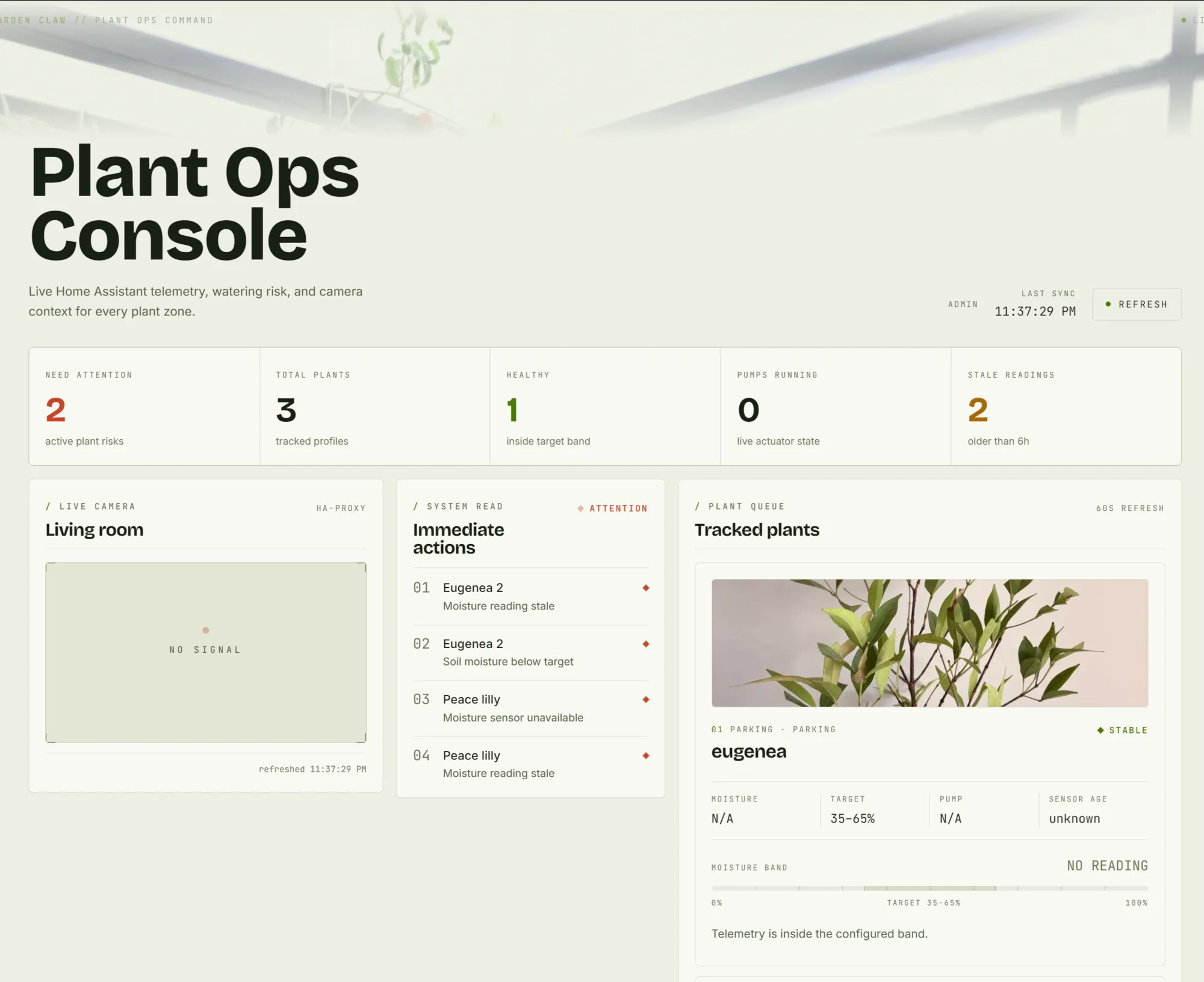
The console: what needs attention, what to do about it, and every plant
I designed the console and built it with Claude Code. I brought the design: what the page should answer, what each plant shows, how it should look. Claude Code wrote the app and connected it to Home Assistant. As a designer, that changed what a side project can be. I went from an idea to a tool I use every day, without handing it off to anyone.
What's next
More plants. Adding one is a sensor and a pump in the pot and a profile in the console. The rule waters it, the AI watches it, and it shows up in the balcony scan at the top of this post with its own live reading.
More than soil, too. Next up: temperature and humidity sensors for the air around the plants. If the air gets too dry, an atomizer will mist it back up. After that, a small weather station, so the system knows when it has rained and the plants don't need watering.